Project Hail Mary
Mar 15, 2026
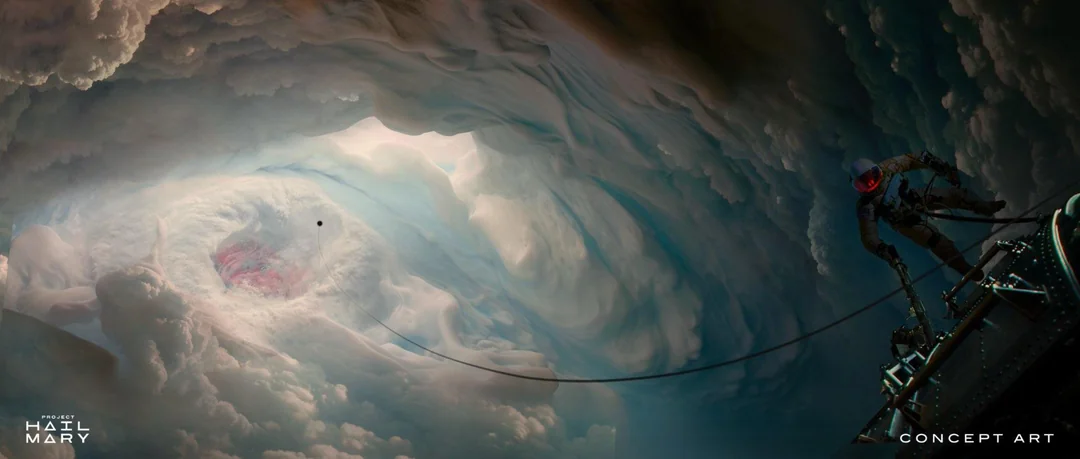
I had the privilege of watching Project Hail Mary (2026) in a pre-screening at MIT. It’s excellent! An amaze entry in the Ryan Gosling goes to outer space cinematic universe.
I’m not going to spoil the movie except for one major development that occurs about 45 minutes in and is shown in the trailer—but I do go into some detail about this plot point.
The aesthetics, oh my god. Ridiculously, ridiculously beautiful film to look at and to feel. No surprise that it was shot by the cinematographer from Dune. It is explicitly influenced by 2001—several costume, production design, and visual effect choices were direct nods to Kubrick— but follows the visual tradition of more recent sci-fi (Gravity, The Martian, Mickey 17, Interstellar, Sunshine Ad Astra, etc.) that emphasizes the objects’ engineering, and it is SOMEHOW still new and surprising. 1 Aside from the obvious—Rocky’s ship—I am thinking of the movement of the spaceships! It’s a choice made for comedy, but it felt refreshing when most spaceships in movies are either boats or dogfighters. Project Hail Mary’s ships move like beautiful crafts of the future. This and a million other subtle details make for a world that feels optimistic despite the grim premise. The film delights in excellent craftmanship and takes every opportunity to showcase it.
And yet.
It chose to go for straightforward plot, characters, settings rather than lean into the mystery and wonder and existential terror of being 12 lightyears from Earth. This is a quality of the source material, as Andy Weir’s whole schtick is hard sci-fi survival scenarios; the plot proceeds from one technical problem to the next, protagonists collaborate, and questions are answered. (The term for this is competency porn.) I have a soft spot for that kind of film. In high school I watched a bunch of these in a row and then spent a year writing piles of terrible screenplays for high-concept sci-fi chamber dramas. None of them worked because they were all written from intellect, not feeling. The ideas and images came to me from dreams but I didn’t look deeper into the unconscious during the writing process. Unseen forces moved me to write about astronauts stranded on deadly planets, children stowing away on starships trying to run away from home, enemies forced to work together to survive in outer space, and friends failing to save each other from brutal gravitational effects. Scenarios whose common theme is intense emotion amidst life-or-death struggle. And instead of locating and elaborating the personal kernel that inspired these stories, I scratched my head over physics equations, trying to ensure the math worked out realistically.
The blockbuster science fiction movies of the last couple decades are, of course, on the whole, masterfully written and in touch with their emotional cores and the mythic unconsciousness that powers their images. My gripe is more precise than that. I take issue with the excessive clarity of their worlds, plots, and characters. They are, basically, too scrutable. I will always love movies where scientists use their wits to survive on spaceships and submarines (and explain how they did it), but I am learning that I am far more curious about the fantasy part of science fiction—fantasy as in otherworldly, strange, transportative—more aligned with Le Guin’s sensibility, which I don’t think is incompatible with hard science. Rather it is a tonal thing, and this assumption that everything needs to be explained. Weir’s books and the current trend in sci-fi limit themselves by this obsession with knowing the answers to mysteries. I’m more interested in the moment of contact with the unfamiliar: what aliens look like in our minds before we see them, and journeys into strange lands where the outsider remains an outsider, so that the wonder is preserved. Is it possible to sustain the state of not knowing? A smarter critic than I would find a way to articulate the connection between this trend and the real end of strangeness in the world, with every place mapped and connected online, culture homogenized, the erosion of the very concept of the frontier such that even fantasy stories cannot imagine a place that is unknown.
There are a precious few experiences I have had of confronting an unknown world. One was entering college, becoming an adult, and wandering the city and maze-like campus buildings. Another was the trailer for The Brutalist. I felt it in Hollow Knight when I entered Greenpath for the first time and realized the world is so much bigger than I expected. And Project Hail Mary managed to make me feel this rare thing, from Grace’s eyes, in the orbit of Tau Ceti, starting with a blip on the radar and a shining, spiny metal object of angelic beauty. The feeling evaporated when the otherworldly became exhaustingly familiar. Rocky’s design follows the new Star Wars playbook: infantilized laughter, pet-like frame and mannerisms, and other anthropomorphic symmetries. Rocky is less heptapod and more Baby Groot. The first minutes of interaction invite the viewer to meditate on the challenge of mutual intelligibility and what is universally communicable (sound? gesture? movement? physics? what if you “see” with sound and not image?), only to abandon these questions entirely in favor of adorableness and a funny voice, dodging complexities of grammar when convenient and centering them when comedic. To be clear, I think the movie is the better for it. I only mean to complain about the dearth of films that take the other route. Who among us, after the passing of David Lynch, is brave enough to deny the audience answers?
As the world becomes more and more mapped and understood—more scrutable—the final frontier isn’t space or the ocean depths, but dreams. I have delighted in the discovery that my own hypnagogic imagination is an exhaustible source of mysteries. On more than one occasion I’ve become haunted by visions not because they were horrifying but because they were not readily mapped by waking logic, because they sit on the boundary of understanding, eminently real, having emerged from my own mind and experiences, but utterly irreproducible. Art is the only recourse because it, like a dream, has the ability to move between worlds:
The way of art, after all, is neither to cut adrift from the emotions, the senses, the body, etc., and sail off into the void of pure meaning, nor to blind the mind’s eye and wallow in irrational, amoral meaninglessness—but to keep open the tenuous, difficult, essential connections between the two extremes. To connect. To connect the idea with value, sensation with intuition, cortex with cerebellum.
Like all artists, we science fiction writers are trying to make and use such a connection or bridge between the conscious and the unconscious—so that our readers can make the journey, too. If the only tool we use is the intellect, we will produce only lifeless copies or parodies of the archetypes that live in our own deeper minds and in the great works of art and mythology.
Ursula K. Le Guin, “Myth and Archetype in Science Fiction” (from The Language of the Night)
It seems to me there is true nobility in endeavoring to explore this final and infinite frontier. Nothing is more subtle and more rewarding and more miraculous than productive, artistic contact with the unconscious. And it is a journey each of us must undertake for ourselves; no one can do it for you. “The only way […] to the image that is alive and meaningful in all of us seems to be through the truly personal,” writes Le Guin. As a result it is not like other frontiers; it is not competitive. You are not against the Soviet Union in the race to the self. But like other frontiers it is a collective effort in the sense that we can more or less equipped, as a culture, to make the journey. We each must find our own path, but great art and great friends can help us go there; art and people out of touch with the unknown and unknowable promise answers in the light of rationality but are unable to provide answers to questions that really matter, questions that don’t sit neatly in systems of waking meaning. Art that rejects primal emotional truth—the truth of dreams—in favor of scientific realism might rise to the level of great entertainment, but whatever it offers to the quest to bridge conscious and unconscious, it offers accidentally, as scraps. It is in this fashion that I saw the shadows of the true myth in Project Hail Mary, even as it resisted itself: the spacecraft that might be friend or foe, the alien who may or may not understand us, the planet we cannot walk upon.
It’s a fun exercise to trace the visual evolution of sci-fi, the various aesthetics spaceships tend to have in different decades. This film makes me want to dive into the sci-fi of the 60s and 70s, before the visual motifs were solidified.↩︎